Chief Scientist Delivers Keynote on Cyprus and the Journey Toward the Virtual Human Twin at European Commission High-Level Event
Chief Scientist Delivers Keynote on Cyprus and the Journey Toward the Virtual Human Twin at European Commission High-Level Event
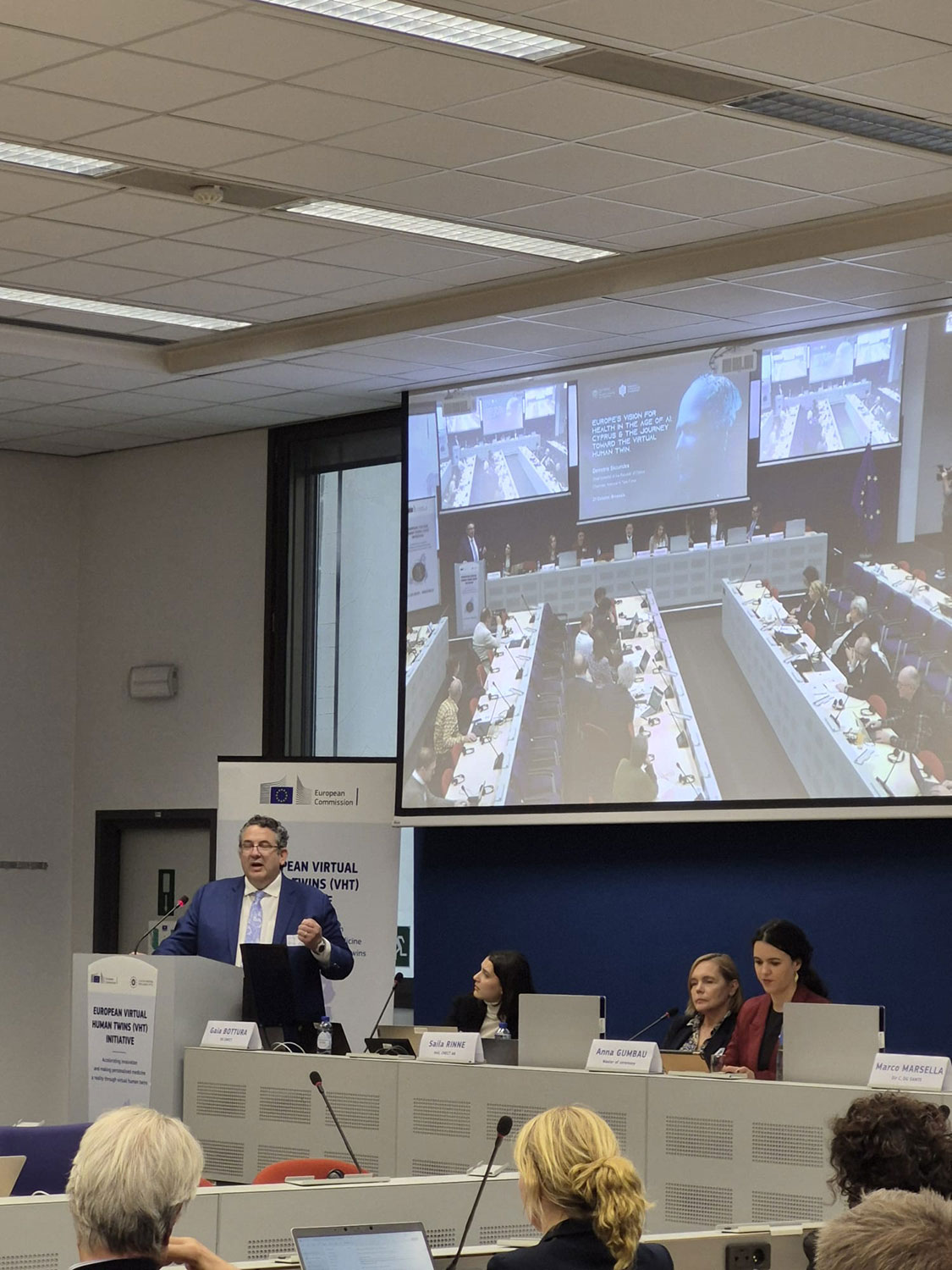
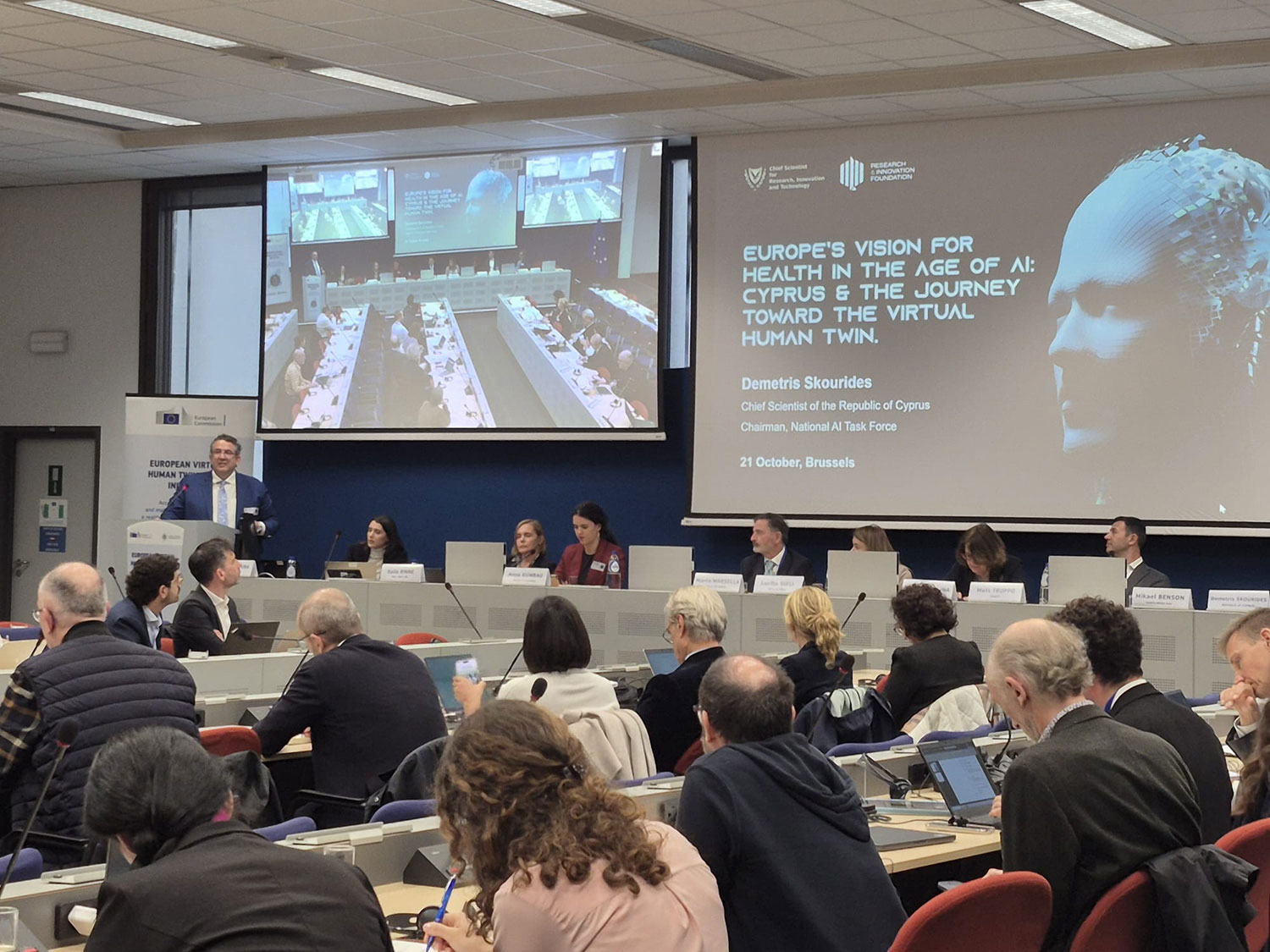
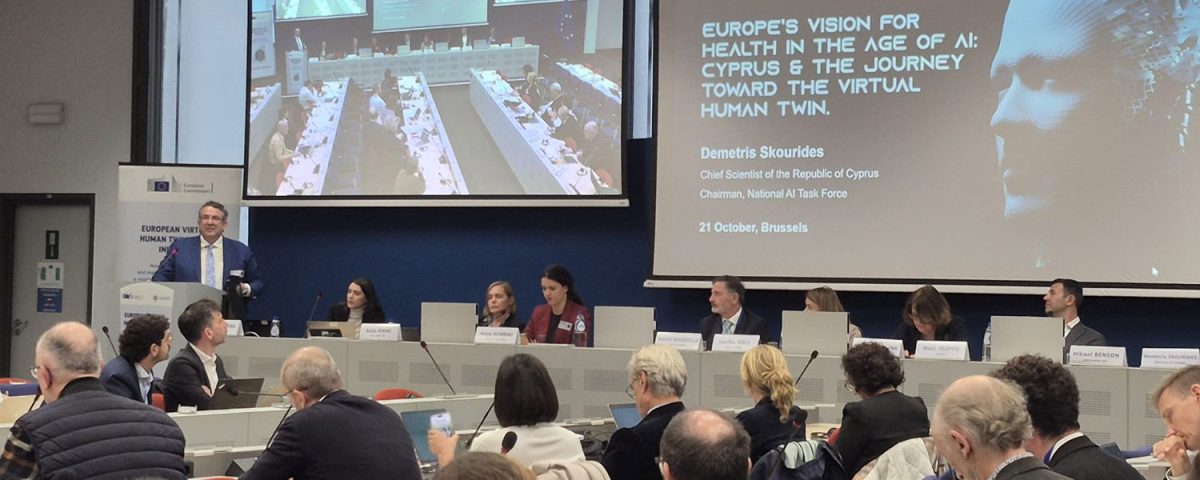
The Chief Scientist of the Republic of Cyprus, Demetris Skourides, attended a high-level event organised by the European Commission in Brussels dedicated to shaping the strategic vision for the European Virtual Human Twins (VHT) Initiative. Mr. Skourides delivered a leadership keynote on “Cyprus and the Journey Toward the Virtual Human Twin”, highlighting Cyprus’s growing contribution to Europe’s efforts to advance AI-driven healthcare, digital health ecosystems, and evidence-based policymaking.
The European Commission’s Virtual Human Twins Initiative, launched in December 2023, supports the emergence and adoption of the next generation of VHTs in health and care. It demonstrates the EU’s commitment to advancing health data infrastructures, supercomputing capacity, and artificial intelligence, aligned with the AI Continent Action Plan and the Apply AI and Life Sciences Strategies.
Since its launch, more than 90 organisations from industry, academia, and research have signed the European Virtual Human Twins Manifesto – a Statement of Intent on the collaborative development and adoption of VHTs across the EU. The Brussels event gathered leading European stakeholders, including researchers, healthcare professionals, industry innovators, policymakers, and Member State authorities, to accelerate innovation and bring VHT technologies into clinical practice.
Notably, Cyprus hosted the First International Symposium on Digital Twins in Healthcare in May 2024, which brought together leading experts and institutions to discuss the role of digital twins in advancing personalised medicine and health innovation. The initiative later held its official launch event in Barcelona in December 2024, by which time dozens of organisations had already signed the Manifesto.
The opening keynotes were delivered by Roberto Viola, Director-General at DG CNECT; Sandra Gallina, Director-General at DG SANTE; Lucilla Sioli, Director, AI Office at DG CNECT; Marco Marsella, Director at EU4Health and Health Systems Modernisation, DG SANTE; Matt Truppo, Global Head of Research Platforms and Computational R&D at Sanofi; and Mikael Benson, Professor, Medical Digital Twin Research Group, Karolinska Institutet.
Together with Demetris Skourides, who was invited to provide a Member State perspective, the keynote speakers focused on the importance of a shared European vision – one that unifies research, policy, and clinical practice under a common horizon.
They emphasised that Europe’s VHT platform is a flagship initiative linking digital science, trust, and healthcare transformation, reinforcing Europe’s global leadership in ethical, data-driven healthcare.
In his keynote, Demetris Skourides emphasised that Virtual Human Twin (VHT) is not the final destination but a vehicle enabling improved healthcare and evidence-based policymaking, echoing his belief that “Europe can lead the world by operationalising the values of trust, ethics, and inclusivity in AI-driven healthcare.”
He underscored the importance of innovation ecosystems and collaboration across sectors and industries, including public–private partnerships. In Cyprus, he noted, there is ongoing collaboration between the medical association, research institutes, healthtech companies, and government, all working toward building readiness, governance, and trust for an AI-enabled healthcare platform that supports medical professionals leveraging Socratic principles.
Mr. Skourides provided an overview of the Digital Twin ecosystem in Cyprus, comprising stakeholders such as the Cyprus Institute of Neurology and Genetics, the German Medical Institute, the National eHealth Authority, CYENS, EPOS-IASIS, KIOS, Anabiosi-Data, and the ERATOSTHENES Centre of Excellence, who together are participating in more than ten European VHT projects.
He elaborated on the work undertaken by the National eHealth Authority in implementing MyHealth@EU for cross-border health services and HealthData@EU to enable secondary use of data for healthcare research. He highlighted the additional effort required to make European Health Data Spaces accessible to all healthtech ecosystem members aspiring to leverage the Virtual Human Twin Initiative.
Mr. Skourides noted that VHT is a journey, and that the initial goal should be to empower medical professionals with the confidence that VHT can provide safe, ethical, and personalised patient treatment at scale. He outlined opportunities such as testing clinical hypotheses, analysing disease correlation and impact, understanding healthcare network effects, supporting the development of medical learning models, advancing next-generation medical-assisted learning, and strengthening evidence-based policy making.
Concluding his address, Mr. Skourides presented his view on enabling technologies and AI frameworks complemented by sovereign technology infrastructure, human-centred AI, and AI ethics as key drivers for the future. He highlighted the steps Cyprus is taking to ensure research organisations have access to sufficient, high-quality data, and stressed the need for further cooperation on operationalising the EU Health Data Spaces, supporting federated learning, and developing new programmes such as AI healthcare sandboxes and Virtual Human Twin accelerators.
Dr. Andreani Odysseos, Director of Biomedical Research at EPOs-Iasis and Ecosystem Building Leader of DigiPredict FETProactive on Digital Twins in Health, welcomes the fact that the transformational vision, the extraordinary technological depth, and the clinical relevance of European Virtual Human Twins (VHT) are now under intense debate. She underlines the significance of an integrated dynamic disease fingerprinting resulting from the combination of both Physical and Virtual Twins, with bidirectional exchange of deep and clinical data, assisted by AI and aiming at an exquisite collaborative partnership model, with true commitment for clinically applicable Digital Twins for the benefit of all sectors of society.